
Select Method
Choose Schneier Algorithm from the available sanitization methods.
CertifiedNIST SP 800-88 Rev. 2 · DoD 5220.22-M · IEEE 2883
Secure 7-Pass Data Erasure Method With Verification & Audit-Ready Certification
The Schneier Algorithm is a well-known multi-pass data wiping methodology associated with Bruce Schneier and his book Applied Cryptography. The method is commonly implemented as a 7-pass overwrite process designed to replace previously stored data with defined patterns and cryptographically secure pseudorandom data.
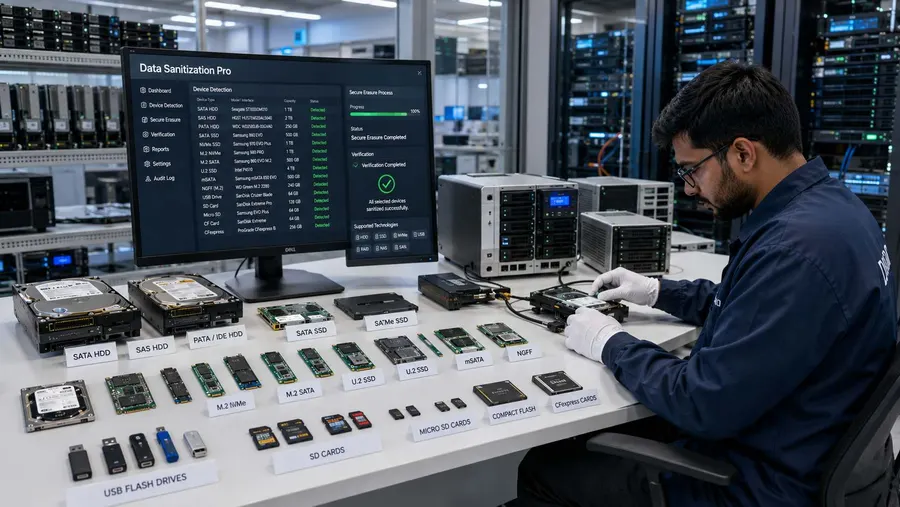
Data Sanitization Pro (DSP) provides a dedicated Schneier Sanitization Method through the DSP Sanitization Engine, enabling controlled execution, process monitoring, verification and audit-ready documentation of the sanitization operation.
The Schneier Algorithm is a historical 7-pass disk wiping methodology designed around repeated overwriting of storage locations.
The commonly referenced implementation consists of:
| Pass | Operation |
|---|---|
| Pass 1 | Overwrite with 0xFF |
| Pass 2 | Overwrite with 0x00 |
| Pass 3–7 | Overwrite using a cryptographically secure pseudorandom sequence |
This formulation is documented in descriptions of Schneier's recommendation in Applied Cryptography.
The objective is to replace the data previously stored in addressable sectors with successive overwrite patterns rather than simply deleting filesystem references.
The Schneier Algorithm should be understood as a data wiping methodology, not as a current:
Its historical significance comes from its use as a multi-pass overwrite approach for storage media.
DSP implements the Schneier methodology as a dedicated sanitization option within its DSP Sanitization Engine.
The software can manage the complete sanitization lifecycle:
Choose Schneier Algorithm from the available sanitization methods.
DSP identifies the selected storage device and records relevant device information.
The software can inspect available device information such as:
DSP performs the configured Schneier sanitization process:
The sanitization process is performed through the DSP Sanitization Engine rather than treating the method as a simple file-deletion operation.
During processing, DSP can provide operational information including:
After sanitization, DSP performs the configured verification process and records the result.
DSP generates an audit-ready sanitization certificate documenting the method actually executed on the selected device.
Deleting a file does not necessarily sanitize the underlying storage.
A normal deletion operation may primarily remove filesystem references or mark storage space as available for reuse.
The original data may remain physically or logically present until overwritten or otherwise sanitized.
The Schneier methodology instead focuses on overwriting storage locations with successive data patterns.
| Operation | Primary Action |
|---|---|
| File Deletion | Removes/references file metadata |
| Quick Format | Recreates or modifies filesystem structures |
| Factory Reset | Device-dependent reset process |
| Single-Pass Overwrite | Replaces addressable data with a new pattern |
| Schneier Method | Seven-pass overwrite methodology |
| Purge | Uses an appropriate technique intended to make recovery infeasible for the specified level of effort |
| Destroy | Physically destroys the media |
The Schneier method is particularly associated with traditional magnetic hard disk wiping.
For addressable magnetic storage, repeated overwriting can replace previously stored user data with new values.
DSP can combine the sanitization process with device-level assessment and post-process verification to create a documented record of the operation.
Modern SSD and NVMe storage requires additional consideration.
Unlike traditional magnetic HDDs, flash-based storage can use:
As a result, repeatedly overwriting user-addressable locations does not necessarily provide equivalent coverage of every physical flash location.
Current NIST SP 800-88 Rev. 2 specifically warns that conventional overwrite practices can be inappropriate for certain flash-based storage because spare cells and wear leveling can prevent the host from directly addressing every location where previous data may remain.
Therefore:
The Schneier 7-pass method should not automatically be treated as a universal sanitization solution for SSDs or NVMe devices.
For modern flash storage, the applicable device-specific sanitization capability should be evaluated, including dedicated sanitize commands or stronger Purge techniques where required.
Modern media sanitization is increasingly technology-specific.
NIST SP 800-88 Rev. 2 states that sanitization techniques must be appropriately matched to the underlying storage technology. It notes that historical multi-pass overwriting practices may provide little additional confidentiality protection on certain SSDs and other flash-based media.
This makes device assessment an important part of a professional data erasure workflow.
Traditional overwrite methods can be applicable where the entire user-addressable storage area can be addressed.
Flash architecture can prevent conventional overwriting from reaching every physical location.
Controller architecture, flash translation, spare areas and device-specific capabilities must be considered.
SD cards, memory cards and USB flash devices may also contain controller-managed flash storage that makes simple multi-pass overwriting unsuitable as a universal approach.
Both are historically recognized multi-pass wiping methodologies, but their structures differ.
| Feature | Schneier Algorithm | Gutmann Method |
|---|---|---|
| Commonly Referenced Passes | 7 | 35 |
| Historical Focus | Multi-pass overwrite | Magnetic/solid-state storage research |
| Initial Patterns | 0xFF, 0x00 | Multiple defined patterns |
| Random/pseudorandom Passes | 5 | Included within sequence |
| Modern Standards Status | Methodology | Methodology |
| Current NIST Standard | No | No |
| Dedicated DSP Method | ✓ Yes | ✓ Yes |
| Audit-Ready DSP Certificate | ✓ Yes | ✓ Yes |
The number of overwrite passes alone should not be interpreted as a universal measure of sanitization strength. Current NIST guidance emphasizes matching sanitization techniques to the storage technology and required level of protection.
The Schneier method and commonly referenced DoD wiping profiles are different methodologies.
| Feature | Schneier | DoD 5220.22-M Historical Method |
|---|---|---|
| Common Implementation | 7 passes | Historically 3 overwrite passes + verification |
| Associated Source | Bruce Schneier / Applied Cryptography | Former U.S. DoD NISPOM |
| Status | Historical methodology | Legacy/cancelled policy |
| Purpose | Multi-pass data wiping | Historical information-security sanitization requirements |
| Current NIST Recommendation | Not a current NIST method | Not a current NIST method |
| DSP Implementation | Dedicated method | Dedicated method |
The historical DoD/NISPOM approach should not be confused with the Schneier methodology simply because both are used in commercial disk-wiping software.
NIST SP 800-88 Rev. 2 is the current NIST media sanitization publication, published in September 2025 and superseding Rev. 1.
Modern NIST guidance does not establish a universal requirement to perform seven overwrite passes.
Instead, current guidance emphasizes selecting appropriate sanitization techniques based on:
NIST specifically notes that historical multi-pass overwrite practices may be inappropriate for some modern flash-based storage.
Therefore, the Schneier Algorithm remains useful as a dedicated historical wiping methodology, while modern sanitization programs should select methods according to the storage technology and applicable security requirements.
DSP identifies the target storage device.
Review device information, storage technology, health and available error indicators.
Select Schneier Algorithm from the DSP sanitization-method library.
The DSP Sanitization Engine performs the configured seven-pass process.
DSP verifies the completed operation according to the selected verification process.
The software records relevant device and sanitization information.
DSP generates an audit-ready sanitization certificate documenting the operation.
A professional data wiping workflow should not treat every storage device as identical.
Before or during sanitization, DSP can provide relevant storage-health information where supported, including:
Bad sectors are particularly important because a conventional overwrite operation may be unable to successfully write to every addressable location.
If the selected device cannot reliably accept the required overwrite operation, the sanitization result should be assessed accordingly rather than assuming that a completed software process automatically means every target area was sanitized.
Verification determines whether the selected sanitization operation completed as expected.
DSP can record:
Validation is a higher-level determination of whether the completed sanitization operation is acceptable for the intended confidentiality requirement.
This distinction is important because:
Successful software execution≠automatic universal sanitization assurance.
The storage technology, device condition, sanitization method and organizational requirements must all be considered.
DSP generates an audit-ready certificate documenting the sanitization operation actually performed by the software.
Depending on the configured reporting workflow, the certificate can contain:
The certificate documents the actual sanitization operation executed by DSP.
It is not a certification issued by Bruce Schneier, NIST, IEEE or another external standards organization.
DSP can support offline sanitization workflows for environments where internet connectivity is restricted or prohibited.
This is useful for:
An offline workflow allows the sanitization operation to be performed locally without requiring continuous cloud connectivity.
For enterprise and ITAD environments, DSP can support processing of multiple storage devices according to the configured licensing and hardware environment.
Typical operational scenarios include:
Each device can have its own sanitization and verification record.
The Schneier Algorithm remains relevant when an organization specifically requires or chooses a defined seven-pass overwrite methodology, particularly for compatible addressable storage.
However, the method should not be selected solely because it has seven passes.
Modern storage technologies have changed substantially since historical multi-pass wiping methods were developed.
A professional sanitization program should consider:
This technology-aware approach is consistent with the direction of modern NIST media sanitization guidance.
DSP provides a dedicated sanitization-method library covering multiple established, historical and technology-specific methodologies.
The selected method is executed through the DSP Sanitization Engine, followed by verification and audit-ready documentation.
The exact method should be selected according to the storage technology organizational policy and required sanitization objective.
A dedicated implementation is available for the Schneier sanitization methodology.
The configured seven-pass process can be monitored throughout execution.
The completed sanitization operation can be verified and recorded.
DSP provides device identification, health and error information where supported.
Potential storage errors and bad-sector conditions can be identified and reported.
Generate documentation of the actual sanitization operation.
Perform sanitization in environments where internet connectivity is restricted.
Designed for professional IT, ITAD and organizational media-sanitization workflows.
Yes. The commonly referenced Schneier wiping methodology uses seven overwrite passes: 0xFF, 0x00, followed by five cryptographically secure pseudorandom passes.
No. It is a historical data-wiping methodology associated with Bruce Schneier. Current NIST SP 800-88 Rev. 2 provides modern media-sanitization guidance and does not establish Schneier as a NIST sanitization standard.
No. The Schneier methodology should not be represented as a U.S. Department of Defense sanitization standard.
Not universally. The appropriate sanitization method depends on the storage technology and sanitization objective. Current NIST guidance specifically notes that historical multi-pass overwriting can be inappropriate for certain flash-based storage.
It can be used as a multi-pass overwrite methodology on compatible addressable storage. Device condition and the ability to successfully overwrite the required addressable areas must still be considered.
The method can be available as a DSP sanitization option, but conventional multi-pass overwriting should not automatically be considered sufficient for every SSD because flash architecture can prevent direct addressing of all previous physical storage locations.
Yes. DSP can generate an audit-ready certificate documenting the sanitization method actually executed, verification information and relevant device/audit metadata.
No. The certificate documents the sanitization operation performed by DSP. It is not an external certification issued by Bruce Schneier or a standards organization.
Data Sanitization Pro runs all 25 standards offline and verifies the result.