
Logical Bad Sectors
Logical sector level issues met during processing are identified and reported.
CertifiedNIST SP 800-88 Rev. 2 · DoD 5220.22-M · IEEE 2883
Advanced, Fast And Audit Ready Data Sanitization For Modern Storage
Sanitize the data. Verify the result. Handle exceptions. Document everything.
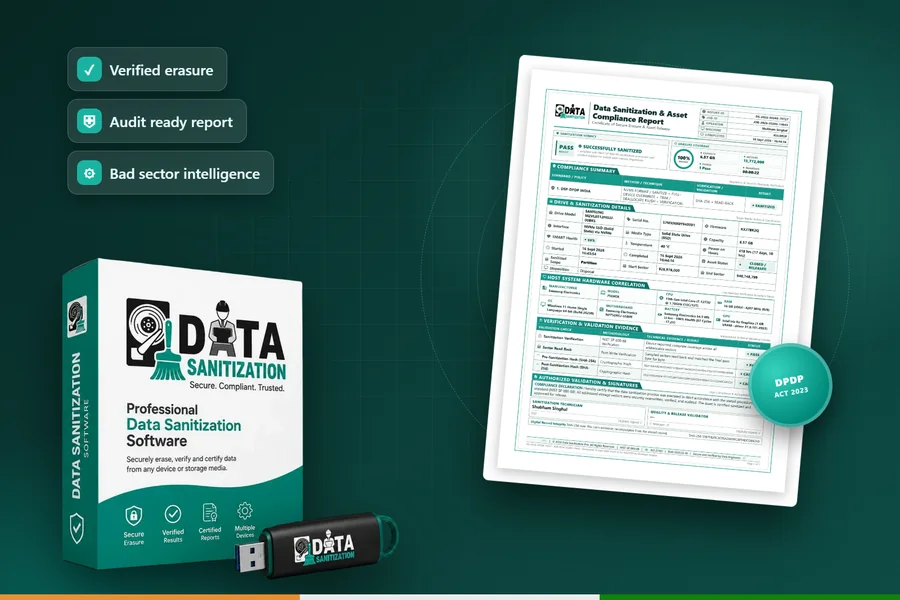
The DSP DPDP Compliance Standard is an advanced data sanitization framework developed by Data Sanitization Pro, Powered by Data Engineers, for organizations that need a controlled, verifiable and audit ready approach to secure data erasure.
It goes beyond basic disk wiping. Sanitization, verification, bad sector handling, multi device processing, storage health intelligence and detailed audit reporting sit in one framework.
India · Digital Personal Data Protection · Secure Data Erasure · Verified Sanitization
NIST SP 800-88 Rev. 2 sets out the sanitization program and IEEE 2883-2022 specifies technology specific methods. The DSP standard is an implementation focused framework that puts execution, verification, media intelligence and audit reporting in one place.
| Capability | Method Focused Approaches | DSP DPDP Compliance |
|---|---|---|
| Secure Data Erasure | ✓ | ✓ |
| Multiple Sanitization Methods | ✓ | ✓ |
| HDD Sanitization | ✓ | ✓ |
| SSD Sanitization | ✓ | ✓ |
| NVMe Sanitization | Varies | ✓ |
| Removable Media | Varies | ✓ |
| Multi Device Processing | Varies | ✓ |
| Sanitization Verification | ✓ | ✓ |
| Detailed Audit Reporting | Varies | ✓ |
| Storage Health Information | Limited | ✓ |
| SMART Information | Varies | ✓ |
| Bad Sector Detection | Limited | ✓ |
| Bad Sector Reporting | Limited | ✓ |
| Logical Bad Sector Handling | Limited | ✓ |
| Pre And Post Hash Information | Varies | ✓ |
| Live Verification Information | Varies | ✓ |
| Offline Operation | Depends | ✓ |
| Enterprise Storage | Varies | ✓ |
| Device Level Audit Trail | Varies | ✓ |
| Unified Sanitization Workflow | Varies | ✓ |
The comparison describes the intended capability scope of the DSP standard. It is not a claim that every implementation of another standard lacks a capability. Actual capabilities depend on the tool, the implementation and the storage technology.
Secure sanitization with efficient execution and measurable verification.
Real storage devices are not always perfect. A conventional wipe can meet these conditions without telling you.
DSP gives you a complete picture of the device, not just "Wipe Completed".
Logical sector level issues met during processing are identified and reported.
Physical media defects are identified and reported where the device and process can detect them.
Read failures and inaccessible areas are recorded as part of the operation.
Storage health information is included in the overall sanitization assessment.
Perform the defined data erasure operation.
Validate the sanitization result.
Record device health, sectors, errors and storage condition.
A consistent sanitization framework across mixed IT estates.
Sanitize many devices at once, with the status and process information of each one in view.
A modern standard does not stop when the data is erased. It answers these questions.
Model, serial number, capacity, interface and storage technology.
Selected method, scope, operation status and execution details.
Verification status and relevant verification data.
SMART data, health indicators, temperature, power on hours and storage errors where available.
Bad sector, read error and processing information where detected.
Operator and system information.
Timestamps, process metadata and completion status.
Where the workflow supports it, live block level views show the data changing during sanitization.
The process stays inside your environment and still produces the full record.
A single generic overwrite should not be treated as right for every technology. DSP selects and applies the approach that fits the storage technology, the device's capabilities and your requirements.
It treats HDD, SSD, NVMe, flash and enterprise storage as what they are, not as if every device were a magnetic disk.
Why 35 Passes Is ObsoletePerformance focused workflows for large capacity and multi device environments.
HDD, SSD, NVMe, removable media, servers and enterprise storage.
Storage health, sector and error visibility.
Results are verified and documented.
Detailed reports give a structured evidence trail.
Built for controlled environments with minimal internet dependency.
Suited to high volume IT asset sanitization.
Developed in India by Data Sanitization Pro, Powered by Data Engineers.
From traditional HDDs to modern NVMe and enterprise storage.
Bad sectors, read errors and storage health form part of the picture.
Efficient processing of large capacity and multiple devices.
Sanitization is followed by defined verification, not treated as done when the process ends.
Device, method, operator, timing, verification and exceptions are captured in the record.
Built around conditions in enterprise, ITAD, refurbishment, government and data centre work.
One Standard. One Workflow. Complete Sanitization Evidence.
Full surface overwrite with bad sector detection and reporting.
Uses the drive's secure erase where supported and records the result.
Technology aware sanitize for NVMe, followed by verification.
Verified overwrite for USB drives, SD and microSD cards.
No. It is a framework developed by Data Sanitization Pro. It is designed to support DPDP oriented data lifecycle processes and to complement NIST SP 800-88 Rev. 2 and IEEE 2883-2022.
HDD, SSD, NVMe, USB drives, memory cards, SAS and SATA drives, servers, RAID, NAS, SAN and enterprise storage.
Device details, the method used, verification status, SMART and health data, bad sector and read error information, operator details, timestamps and the final result.
Yes. Sanitization runs offline and the evidence record is produced inside your own environment.
Data Sanitization Pro runs all 25 standards offline and verifies the result.